
Using Vintage M42, "K", "M" and "A" lenses on Pentax
1. Overview 2. M lenses. 3. M42 lenses
This is the first of three pages in which I try to provide a more comprehensive look
at the ins and outs of using vintage lenses on Pentax DSLR's than is currently (AFAIK)
available on the web. It is a particular Pentax USP that their cameras are backwards compatable with the
array of vintage lenses, the K mount
not having changed in its basic design since its inception in 1975. And because before then
Pentax used the M42 mount, they kept the
registration distance
the same, so M42 lenses
are also easy to mount with a simple non-optical adapter.
Only Nikon has a (not quite) comparable backward compatability. All the other main manufacturers have, at some point,
completely changed the lens mount, rendering earlier lenses unmountable.

|

|
The pics show SMC-M and M42 prime (ie non-zoom) lenses that I use with my Pentax K-r DSLR. You can see the identical P-KM mount of the two SMC-M lenses on the left, a mount that is the same in all respects to the mount on eg a modern 18-55mm kit lens except for three: no electrical contacts, no autofocus connection and a second mechanical connection in a slot opposite the protruding aperture lever. The other three lenses are of the more ancient M42 screw-in mount: (L to R) Pentax Takumar 55mm f2; Russian made Helios "Carl Zeiss biotar" 58mm f2; Panagor 135mm f2.8. With these an adapter is required to mount the lens on the camera (see below).
I also have manual focus lenses with electrical contacts on the mount. Apart from the manual focus (and the need to do the setup detailed below) the operation of these is not really so different to modern autofocus (AF) pentax lenses. I also have a number of Tamron "Adaptall" lenses with interchangeable mounts, these are discussed on my adaptall page.
So why bother with these?
- Image quality. Many of these vintage lenses are really good.
- Fast apertures. The standard 18-55mm kit lens is f3.5 to 5.6 (f number increases - ie smaller aperture - as you zoom to 55mm). The SMC-M 50mm f1.4 is almost four stops faster (as we say) than the kit lens at 50mm. Not only does this give more options and faster shutter speeds when the light isn't bright, it also gives more creative options - eg shallower depths of field to isolate a photographic subject.
- Cost. Typical used auction price (UK) for the 50mm f1.4 SMC is £50-80 - a fraction of the cost of a new lens (SMC-M 28mm: £30-50; Takumar 55mm:£20-80; Helios 58mm: £10-50; Panagor 135mm:£10-30).
Using the lenses
"K", "M" (and "A") lenses
The first range of Pentax bayonet lenses are referred to as "K" lenses. Their essentially similar successors were the "M" range, and they were followed by the "A" lenses with electrical contacts for auto aperture. The initial set up (Pentax K-r, other models are similar) to use all these lenses is the same. In a nutshell:
- i. Dive into your camera set up menu and set "use aperture ring - permitted".
ii. (may depend on DSLR model) Set "green button action" to "Tv shift".
iii. Online advice says don't leave on "auto-ISO"; set to a specific number. - Change the focus setting to "MF" - manual focus*.
*leave on AF for Catch-in (AKA trap) focus. - Set lens focal length (for the shake reduction) - easily done by switching the camera off then on.
- Use M (= manual) mode. Manually change the aperture using the aperture ring.
- Press the "green button" to meter. Use the E-dial
to fine tune the shutter speed. Shoot!
If the exposure of the image is not quite right, adjust and retake. - For "A" lenses you also have the (preferred) option of putting the aperture ring onto the end position marked "A" and using A, Tv, P automatic modes. Apertures will now be displayed - and set - on the camera and recorded in EXIF data.
The specifics for a Pentax K10D are described by Robert Donovan, with big clear pics, on his blog. This post from dpreview.com is for the K100D.
The ins and outs and differences between camera models, metering/compensation issues and why we refer to the "crippled K-AF mount" are the subject of page 2.
M42 lenses
For M42 lenses the picture is more involved: there are different varieties of M42 lens, and different varieties of M42 adapter to mount the lens
Adapters
The pic shows my four M42 adapters, which are pretty representative. The shiny rimless
one is an original made in Japan adapter cost £10 used (very similar to a genuine original pentax one).
Next to it is a modern Chinese clone with key, cost £5 new. The Kipon (£5 used) is also a Chinese made rimless one but
with an occasionally significant extra design feature of a rear inside flange. This depresses the
small pin on the M42 mount (arrowed in pic above), the point of that is addressed
by photographer Hin Man on his blog
(see also my review).
All adapters are placed in the cameras' bayonet mount in a
similar way by lining up the usual red dot and rotating clockwise, using fingers or a key,
till it clicks into position. All these three will be
flush with the camera mount.

I should mention also that the painted nature of this particular mount means that there can be conducting/non-conducting mount issues as discussed on page 2.
This thread on pentaxuser forums offers a photographers appreciation of the quality and usability of respective adapters (see also accessory reviews on Pentax forums). I can mention that there are many who would be cautious about the Chinese clones: see below for links to a couple of threads.
M42 variants
My M42 lenses in the pic above are of what I can call the main, and most common, variety.
They all have the small aperture pin, and an A-M (auto-manual) switch (red dotted).
The effect of this switch on dslr's, once you have set an aperture, is to flick the aperture from wide open (A)
to your chosen aperture (M). Basically its very useful.

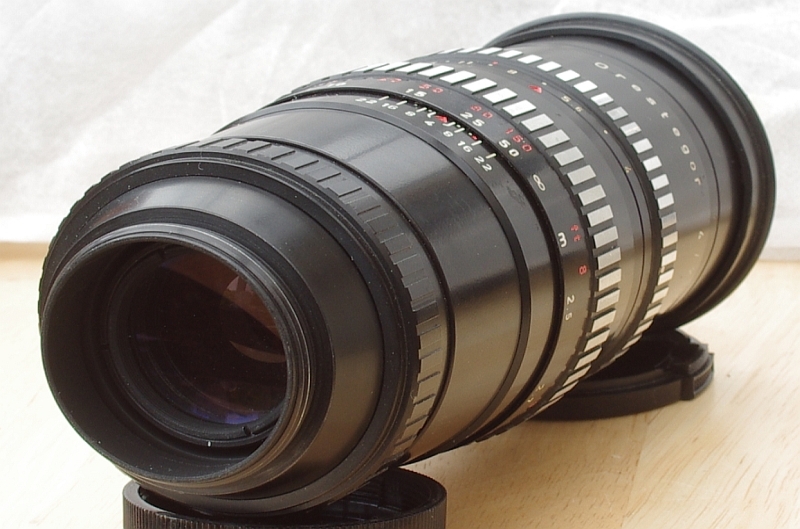
This 200mm lens has no pin or A-M switch, or indeed any aperture connection at the mount end. The aperture ring is near the front of the lens. Alongside it is another ring that limits the movement of the aperture ring. To set an aperture click this second ring into position, then the aperture ring can be spun smoothly into position just prior to depressing the shutter.
 Takumar pin
An extra small feature of my takumar lens is another very small pin (circled) that locks the A-M switch until it's depressed by screwing the lens into the mount. One important point is that with the Kipon adapter this pin catches: so if you have a takumar or similar lens with this pin TEST IT with your adapter OFF the camera to check for this problem. If you don't you may find you are unable to remove the lens from the camera.
But overall, apart from the particular case of an automatic M42 lens without an A-M switch (see link below re: "modding"), there isn't any major difference in using the variant M42 lenses.
Using M42 lenses
The initial camera setting up to use M42 lenses is the same as for P-KM lenses. With an adapter in place, the lens can be screwed on to the camera (some photographers leave the adapters semi-permanently on the lens and mount/demount them like a K-bayonet lens). My experience, particularly with the cheap adapters, is that the lens just doesn't quite line up correctly at 12 O'clock - just have to live with that.
The principal difference between using M42 and K-bayonet lenses is due to the
protruding aperture lever on the K/M lenses. On mounting the lens this lever is engaged
and holds the aperture open, thus giving the advantages of open aperture focussing
(= bright viewfinder and smallest depth of field).
On pressing the green button, the camera closes the lens down to the selected aperture to meter.
Most ofter we use `M' manual mode with M lenses. Actually you can use `A' aperture priority mode! However the
lens will be limited to wide open aperture only. Even if you change the aperture ring position,
the lens won't stop down when you press the shutter when using the lens on a DSLR
(unlike my film ME-super see page 2).
With M42 lenses the aperture is not held open. The photographer can - has to - do the stopping
down, using the aperture ring and/or
the A-M switch. This means that `A' aperture priority mode can, in principle, be used unrestricted
to wide open aperture and for me this is the preferred mode.
It was my hit-and-miss learning to use M and M42 lenses, with a lot of browsing the net, and my appreciation that the ideal of easy, problem-free usage of these lenses hasn't quite been realised by Pentax, that has prompted these pages. Page 3 is the discussion of using these lenses with specific reference to the metering, connectivity and inconsistency issues.
Samsung Cameras
Samsungs' initial move into DSLR cameras was a collaboration with Pentax. Their first models, the GX1S/L, GX-10 and the GX-20, were rebadged Pentax *1st DS/DL2, K10-D and K20-D respectively. They thus have the K-mount and the same lens compatibility as the Pentax cameras. Since then Samsung have designed their own non-compatible camera mount and are pursuing mirrorless camera systems.
For the purposes of using these lenses these cameras can be regarded equivalently to the pentaxes.
Useful Links/More Info
1Ricoh bought Pentax from Hoya in 2011. Pentax is continuing as a/the brand name for cameras.
- Pentax Forums. The main community run forum. Lens reviews. Accessory reviews.
- Pentax User Forums. This forum is run by the publishers of ePhotoZine online magazine.
- Manual lenses forum. A mine of info on vintage lenses and their use.
- Manual focus forum. Alternative to mflenses.com
- Lens mount identification page. - Rick Oleson.
- Ken Rockwell, a well known on line commentator, discusses crop factor and depth of field. Mounting other lenses on Pentax:
- Olympus OM: DIY mod to PK.
- Contax-yashica DIY mod described by mflforums veteran.
- Leitax - commercial mount changing. Olympus OM to PK. Contax to PK Leica to PK M42 adapters:
- Stuck M42 adapter.
- Stuck M42 adapter - a solution . Modding:
- Mod M42 automatic lens Hin Man relates his attempts to fix the pin.
- Mod Konica mount to PK
- Mod P-KM 2x TC to P-KA Firmware
- Pentax Hack Most pertinent thing is access to debug modes for pentax cameras.
Comments
Please share any insight you may have from using manual lenses with your pentax camera.
I am the moderator for comments. I reserve the right to
delete all comments that do not enhance the content of the page. All offensive etc. comments will be deleted asap.
PRINT THIS PAGE? I recommend PrintFriendly.